sabato 24 marzo 2012

Karishma D'souza


Can you describe your work?
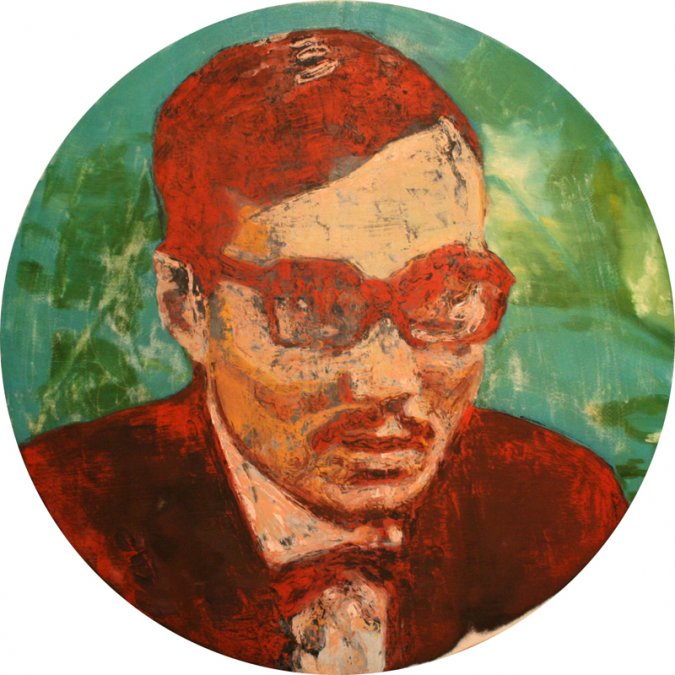
My paintings work for me as tangible memory holders, spaces of unearthing. On a recent trip to the edge of the Sahara, the dunes were another reminder that change is constant, and that nothing can be grasped too tightly. In my work however, I attempt to document certain truths that persist through the noise and clamour one can find oneself in if one is not careful.


What are you working on?
I am working on a body of oil paintings of sizes that are intimate, of around one foot square, and smaller. The act of painting grounds me, and helps me negotiate new spaces. Through painting I attempt to work out the question of how one nurtures the intensity of communications. 


What inspires you?
The visual arts and literature – locations where one finds oneself in the inner worlds of others; The seamless shifting between the ‘real’ and the spirit world in Ben Okri’s The Famished Road, the intensity of Italo Calvino and Murakami, the author sidestepped in a translated Marathi short story. I hold close the poetry of T.S.Eliot, Maya Angelou and Kabir; and the startling, almost un-graspable humanity in the works of Vermeer, Bruegel, and Rembrandt, seen in the flesh on recent museum visits. I delight in the ethereal finesse of Persian and Mughul illuminations.


What do you hope to evoke from your viewers?
My paintings are often spaces through which I keep what is most dear to me at hand. They are for me a documentation of what has impacted me most in everyday living. They are a way to communicate and reach out to the world around me, and to hold the dialogue, in an attempt to slow down the slipping away of intangible things, or at least to hold a memory of them.


How has your work grown and changed?
For me painting is a space where I can speak about anything I wish to – and hear the echo. Life pulls along and creates references in its wake, from direct experience, and from re-lived experiences communicated by others, which get woven into or lie beneath the parallel made-up world. Painting has always been a space of reaching out. 


Do you experiment with different mediums a lot or do you prefer to work within certain parameters?
I work with oil on canvas, and watercolours. I find that oil painting is always a tussle - which can be very rewarding. I can traverse an infinite range of negotiations with it – from the most immediate to the image that demands time and building up. 


Can you tell me something about your residency in Rijksakademie?
It is very important that Art is given equal respect and funding as the other fields of research. With the spending cuts the future of the academy, from where it is physically housed, to how it has been conceived, is in jeopardy. The atmosphere the Rijksakademie has built is one of inquiry. It has a wonderfully open environment with discussions and conversations that occur casually over the day in studios and over meals, with resident artists and visiting advisors, which always brings something new to deliberate over; which is enriching. The fact that the artists come from such varied backgrounds, disciplines, and experiences, makes an encounter with each person in a way a step outside my world. The connection of art is the first meeting point and it expands from there to keep being returned to at different intersections. I hope to use the duration of the residency as time dedicated to absorb the opportunities for discussions, travel and seeing art, the experience of living in the Netherlands, and negotiating all these new encounters through the work I will do during my time here. 


Is there anything else you would like to add?
I would like to thank you for your interest in my work, and for the invitation to be interviewed for the Arte da Ardere blog.


martedì 7 febbraio 2012

Marcelino Stuhmer

Can you describe your work?
My work hovers between the use or juxtaposition of different materials and media, including painting, photography, film, video, performance, and architecture. My work constructs narrative strategies and artistic discourse concerning representation.
The work reflects mythologized subjective and collective interpretations of current events, history, social communication, and the layers of identity.
The Recurring Dream (2007-8) is a large-scale panoramic painting (2.5 meters high, 4 meters in diameter) that depicts the famous dream sequence from Cold War film classic The Manchurian Candidate (1962). In this scene, the camera pans 360º around the room transforming from an elderly women’s tea-time lecture on gardening into a brutal Communist display of mind-control.
The ambiguity of this scene mixes perception and hallucination, which was not only at the center of the language of nineteenth century panoramic painting, but also refers to current media practices in fabricating patriotic and illusory perceptions of conflict and torture.
The installation Get Ready to Shoot Yourself, 2009 is based on a film set from Orson Welles’s film The Lady From Shanghai (1947), which features the aftermath of a shootout in a mirror maze. It is essential to the concept of the installation that the publicity still photograph that was the basis for this project was purely for publicity purposes only and did not appear in the film, it was in fact a lost staged moment outside the fictional narrative. I was immediately intrigued with the idea of pushing this 2-dimensional tableau image back into 3-dimensional space, re-constructing the image and fictional set that encapsulated the film’s complex narrative. In the installation the viewer walks directly intothe space of the image taking on the roles of both actor and interpreter within the reconstructed, yet broken mirror maze. Allowing the viewer to wander with their own image constantly displaced, reflected, and shattered suggests a contemporary fear and desire to “reside” within images.
This is a homage to Manet, to Velazquez, and to the mirror as metaphor and as another space, where “I am here, but I am also over there,” as Foucault describes it.
Get Ready to Shoot Yourself, 2009: http://marcelinostuhmer.com/Projects/26.html


What are you working on?
I’m currently working on another large-scale installation, a screenplay, and series of paintings, sculptures, collages, and photographs all as part of an on-going multi-disciplinary and complex fictional project I started in 2009 called The Choreographed Accident: Objects, Images, and Artifacts from the Pavel Avorsky Museum, Warsaw, 2009-present. The work collectively examines a Secret Service agent Paul Avery’s (aka Pavel Avorsky) series of clandestine “Warsaw Notebooks” that investigate top-secret British military research into time travel. Avery, the son of a brilliant Polish physicist who worked in the early 20thcentury with Einstein and R.B. Jeffries on time displacement experiments, discovers and explores his father’s scholarly work. The story is told through 2 fabricated newspaper clippings (see links below), paintings, collage, photographic light-boxes, sculptures, and a multi-media installation. I like the idea of a story that takes 5 years to tell, and this ongoing narrative reevaluates cinematic forms of mythology. The content of this project continues to grow creating the need to reevaluate everything learned from a previous experience with the work. The story firmly sits within the genre of the Cold War spy movies with double agents, scrambled communication and evidence that unfold in a “wilderness of mirrors.” It is a dystopian sci-fi, detective thriller that is “stranger than fiction” in the models of Solaris, Alphaville, Notes from the Underground, and the writings of Kafka, HG Wells, George Orwell, Grahame Greene, and the mazes and labyrinths of Jorge Luis Borges. The Choreographed Accidentdescribes a socio-political framework of totalitarian oppression where the individual is a non-person in a psychologically suspicious, paranoid, and neurotic society, where artists unconsciously censor themselves communicating metaphorically, and where improvisation is inhumane. The complex network of fabricated materials and objects creates a conceptual cinema that plays out in the imaginations of the viewer. In a digital age where the manipulation or staging of events is always possible, images that document history don’t have to be truthful, they just have be believable.


What inspires you?
 …an incomplete list in no particular order: concepts of the underworld in mythology, literature, and painting, subways, grottos, mirrors, mise-en-abyme, Siennese painting especially Sassetta, getting lost in Rome and Milan, Michelangelo Antonioni’s L’Aventura, L’Eclisse, Red Desert, Zabriskie Point; Orson Welles’ Citizen Kane, Lady from Shanghai, Mr. Arkadin, Godard’s Alphaville, Hitchcock, Jacque Tati’sPlaytime, the writings about photography by Sigfried Kracauer, Susan Sontag, and Roland Barthes, Jacque Ranciere, Jorge Luis Borges Labyrinths, Exactitude in Science, etc, etc, Walter Benjamin, Adorno, Slavoj Zizek, Helio Oitcica, the spatial and organizational plan of Mondrian’s 1913 Paris Atelier, Tacita Dean, Rudolf Stingel, Joan Jonas, Anri Sala, Michelangelo Pistoletto, Ilya Kabakov, Marcel Duchamp’s Etant Donnes, Robert Gober, John Heartfield, Andy Warhol, The Velvet Underground, The Plastic Exploding Inevitable, Dan Graham’s Rock My Religion and his conceptual architectural model “Cinema”, Gordon Matta Clark, the anatomy theaters in Padova and Leiden, the 1930’s German Total Theater of Erwin Piscator and Walter Gropius, Kurt Schwitters’ Merz concept, Tatiana Trouve, Bob Dylan’s Boots of Spanish Leather, A Hard Rain’s A-Gonna Fall, It’s All Over Baby Blue; Los Carpenteros and Frederick Keisler and Imaginary Architecture, the film Russian Ark, The Cabinet of Dr. Caligari, Gilles Deleuze’s Cinema I and II, Kubrick’s 2001 in relation to Tarkovsky’s Solaris, Miles Davis soundtrack Filles de Kilimanjaro, Bitches Brew; Ornette Coleman’s Free Jazz, Billie Holiday, Nina Simone, the sound of Nico’s voice, Thierry de Duve, Jeff Wall, Richter’s October 18, 1977…


What you hope to evoke from your viewers?
Whether on a canvas or within a participatory installation, I wish the viewer to find themselves confronting their own identity, occupying a specific spatial context as both a character and interpreter of the parallel space, narrative, politics, and time.
I’m fascinated with how the digital age has completely shifted how film is experienced, and how viewers have taken ownership of cinema as a modifiable consumer product in which the temporal and spatial elements can be re-ordered with the simple tool of the remote control.
The typical viewer has become a kind of undeclared VJ within our culture.
I want to give viewers the same freedom within my installations to perform and interpret the work based on the own terms.

How your work has grown and changed?
When I studied at the School of the Art Institute for my MFA, I was a die-hard painter. I dabbled a bit in video, but it wasn’t until I came to the Rijksakademie where I truly explored a variety of materials, media, and narrative strategies. I started with juxtaposing spoken narrative with a series of paintings. I then created my first film My Baby Just Cares For Me, 2001-2, which examined the profiling of immigrant Muslims that began to take form in the early 2000’s throughout Europe. The film featured an American architect at a Brussels train station watching a Muslim couple from a distance and immediately questioning whether the young man is mistreating his girlfriend. The story was written while I was living in east Amsterdam in the Indische Buurt (the East Indies Neighborhood) in a Turkish and Moroccan neighborhood. Although I have a Dutch citizenship I found myself feeling more at home in my neighborhood than among the Dutch. My own Post-Colonial Dutch and Indonesian cultural identity, as both Christian and Muslim, was certainly beneath this exploration. Since leaving Holland in 2004 my work has continued to deal with the questioning of identity but through the collective means of popular culture. The Silva Screen is another painting series that deals with the concept of a questionable cultural identity.


Do you experiment with different materials a lot or do you prefer to work within certain parameters?
I constantly explore process and materials to find a direction for the most relevant and enigmatic means to tell a story.
For example, I had the opportunity to create a performance for the Bergamo Film Festival, I collaborated with an Italian drummer Tiziano Riva who created a new drum solo soundtrack for the video Last Breath on the Mirror, 2009, the video playing within the Get Ready to Shoot Yourself, 2009 installation, creating a new conceptual and temporal relationship with the film sequence. Tiziano Riva performed his drum solo on the film festival stage, with The Last Breath on the Mirror projected above him.
The reference to music as a silent film accompaniment was clear enough, yet I decided to have Riva take the stage in the role of a Buster Keaton, an idea that could only come to me after I met him and I noted that his uncanny facial resemblance.


Can you tell me something about your residence in Rijsakademie?
My experience at the Rijks was full of amazing experience being in close contact with a remarkable cross-section of international artists, global and personal political concerns, and conceptual strategies.
The advisors were fantastic, and the opportunities to show my work to a larger audience was very helpful and led to some direct professional contacts. It was a great learning experience, however, I feel that my time there was a very transitional period. It wasn’t until after I left that I began to really shift my work into site-specific installation, performance, and narrative space. In fact my sketchbooks from that period are full of drawings of installation ideas, many of which I only explored much later.
I’ve learned to trust my instincts as an artist.


Is there anything else you would like to add?
Thank you so much for the opportunity to share my thoughts with you and your readers.
I wish you all the best with your blog and your future curatorial adventures.

giovedì 26 gennaio 2012

Fabian Luyten

Can you describe your work? 
Its about scale, love to create meeting points (partially functional conctructions) in public space, indoors/ outdoors, the artpieces are architectural in the broadest sense of the word (physical, social, mental), how does the surface work in these constructions, 
how is colour related to it, how does it affect the viewer. 
(For further info: there is an english version of a text available on my website: 'the multi-perpectives constructions of Fabian Luyten'. 

What are you working on ? 
A public sculpture near by a large new building for 70 demented patients. 
The building is a new nursing home.


What inspires you? 
Daily life (city, village), mental and social conditions of people, inter-human fabrics of a community (that also architecture to me).


What you hope to evoke from your viewers? 
To underline and question the mental and physical presence of the viewer through their body scale and daily living conditions.


How your work has grown and changed?
More and more working in real life public spaces.


Do you experiment with different materials a lot or do you prefer to work within 
certain parameters? 
Each design of a sculpture needs to be durable as long as possible in outdoor conditions, therefore i need to examine different materials related to what i want to achieve artisticly, like plexi, stainless steel, paint, concrete, glass, wood, electric lightning in the sculputeres if needed and so on. These practical decisions are incorporated as much as possible during design process.


Can you tell me something about your residence in Rijksakademie? 
Very intense and very international, fantastic to meet big artists in your own studio with your own work, great technical working conditions.


Is there anything else you would like to add?
Thank you for your interest in my work and keep it genuine! 


martedì 24 gennaio 2012

Philipp Kremer

Can you describe your work? 
I can describe figurative painting, comparing it to film. 
You have a plot, setting, subject on the one hand, and staging, formal decisions on the other. 
Through the interaction you can balance out a complex content. 
The subject could for example be placed in a different time, while the production and execution tells quite precisely the era of creation... 
Or you can talk about dark, sad things but show an optimistic position at the same time, by being playful and funny on a formal level. 
From that point of view you could call my work “physical one-image-silent-movies”... 

What are you working on ? 
My last work is a wall installation in my studio at the Rijksakademie in Amsterdam where I combine several subjects and panels to form a scene that covers the walls. 
I  followed a baroque idea of integrating paintings into the whole design of a room and saw the contemporary equivalent to that in stretching out the painting  from the bottom to the top of the wall, creating a “theme room”. 
The panels were: a girl with a horse, a sunset, a muddy field, a tractor in front of a farmhouse. 

What inspires you? 
Mainstream culture and the way it works with stereotypes interests me as an image that we as a civilisation create of ourselves. 
When it is made in a very just, efficient way, laying blank the method, or when it uses cliches as modules creating a content that is in the end particular and abstract, it touches me... 
Trying to trace it in an exaggerated way, with the effort to put a lot of heart and devotion to it, I deal with it in my work. 


What you hope to evoke from your viewers? 
Provocation is not easily possible today, so at least I can irritate, or squeeze the mind a little... 
But I want to be honestly feeling in the same time, it becomes a “subtle provocation”. 
I am not searching for a one-time effect, I want to iconify this ambiguity, I think there is a relevance in images that represent ambiguity. That is what I try to do with painting.

How your work has grown and changed? 
I wanted approach my work from an abstract view on painting. 
Trying to avoid narrative associations, I developed constructions with lines playing with logic, related to the human by being obviously 
hand-made. 
When I began to introduce narration into this game again, it got more complex: I can now lay more sensitivity into the colours and the brushstrokes, and be more playful choosing the subjects.


Do you experiment with different materials a lot or do you prefer to work within 
certain parameters? 
I do experiment with painting, I play with other media, made comics and electronic music. 
Within the process of one work I strictly follow my initial plan, which always leaves space for inspired, descriptive decisions.


Can you tell me something about your residence in Rijksakademie? 
It is a special place with many interesting people and the exchange is very enriching.
To have the contact with artists from so many different places is arousing. A good place to develop my work, with fantastic facilities. 


Is there anything else you would like to add? 
Thank you.

lunedì 23 gennaio 2012

Victor Florido

Can you describe your work, content of your work?
I work trying to create atmospheres in my paintings, moods. I´m interested in the uncanny, and how familiar things in their usual context can become theatrical and threatening.  I usually take the canvass as a stage, where a story is being told, but in which we`re left with one still image to look at.
What are you working on?
Right now I´m working on an installation for a gallery, recreating the spaces from my paintings.

What inspires you?
David Lynch, Alejandro Jodorowsky, J.L.Borges, Gregor Schneider, Matt Mullican.

What you hope to evoke from your viewer?
I hope people can experience the dullness of color and the lack of certainties, midway between understanding and not understanding at all.

How your work has grown and changed?
I´ve always been interested in the subjects described above.  But as I improved my skills as a painter I also became more able to manipulate narrative elements in order to make my paintings more effective.

Do you experiment with different materials a lot or do you prefer to work within certain parameters?
I prefer to work with oil paint. I believe that mastering the use of one material is a big step in an artist´s development. Experimenting with a wide spectrum of artistic practices can prevent the mastering of any.

Can you tell me something about your residence at Rijksakademie?
It was an interesting experience; maybe I was a bit too young then. But it helped me to reconsider painting as a problem in itself, and to broaden up my scope of technical resources. In that sense I have to be very thankful to Avis Newman and Lisa Milroy.

Is there anything else you would like to add?
I think today´s art scene is somehow overtaken by ideas come from conceptualism. It is supposed that every artist can describe his work in 500 characters and express his views into written “projects”.  And I believe that many artists do not fit in this frame. Many times we don´t see an art piece before we ask “what is it about”. Art appreciation has become very text-dependent.   And I believe that a big part of the aesthetic experience is left blank due to this kind of one-way approach.  We should also give value to the “not understanding” in art.